BSc in Information Technology

About

The Program

Explore the academic profile, historical development, learning outcomes and quality assurance framework of the BSc in Information Technology.

Department & University History

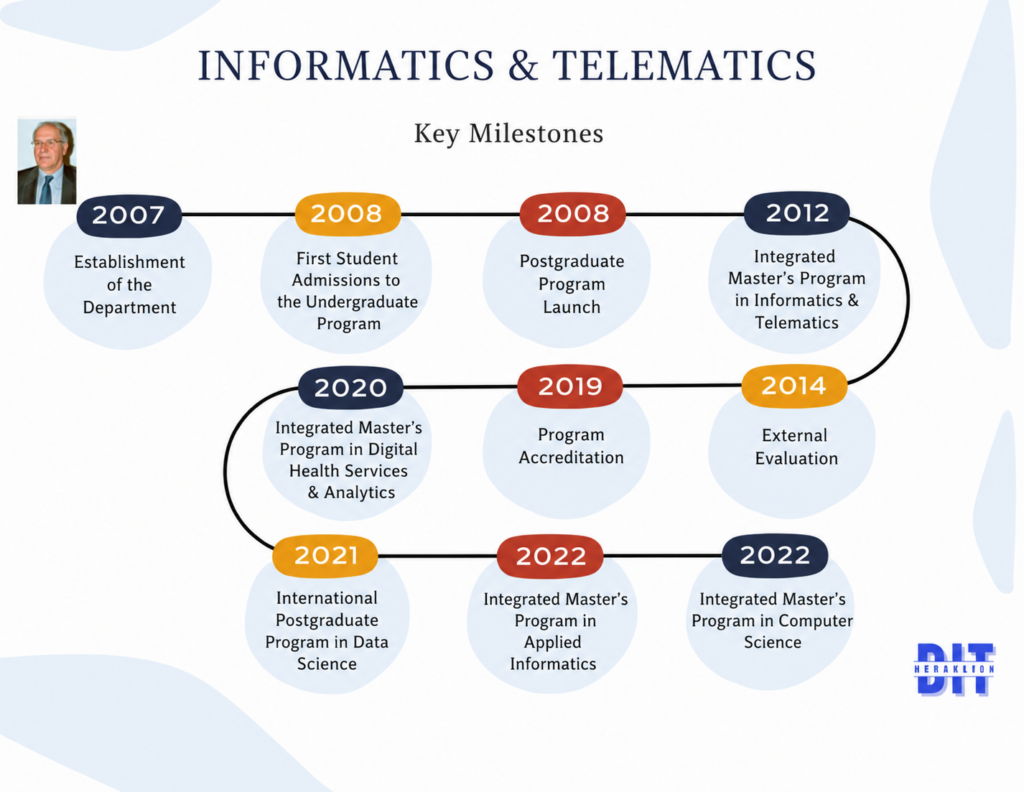
The Department of Informatics and Telematics (DIT) of Harokopio University of Athens was founded in 2007. It realized the strategic vision of the late Professor Georgios Karabatsos, who proudly served as the University’s very first Rector.

Since its establishment, the Department has followed a steady and dynamic upward trajectory. It continuously optimizes its performance indicators regarding academic excellence, state-of-the-art student services, and the global impact of its pioneering scientific research activities.

Key Quality Milestones:
  • External Evaluation (2014): In September 2014, the Department underwent a rigorous review by an international External Evaluation Committee. The final report officially documented the exceptional academic and research progress achieved during DIT’s first seven years of operation.

  • Undergraduate Programme Accreditation (2019): In February 2019, the undergraduate curriculum was formally accredited by the Hellenic Authority for Higher Education (HAHE). This accreditation stands as a testament to the high-quality academic standards and educational environment maintained within the Department.

The Foundation

Harokopio University of Athens is named after the national benefactor Panagis Harokopos, a cosmopolitan Greek of the diaspora with a European orientation, who envisioned an educational institution with excellent building facilities and equipment, in harmony with the natural environment and offering the most modern scientific advancements.

This vision allowed for the full utilization of the assets of the benefactors, both Panagis Harokopos and Evanthia Harokopou-Petroutsi.

Establishment & Development

Chronologically, it is the 18th Higher Education Institution (HEI) of the country. It was established under Article 9 of Law 1894/90, initiated by Professor Georgios Karampatzos (†2011), with the title “Higher Education Institution of Home Economics.”

The title was amended by Article 17 of Law 1966/91 to “Harokopio Higher Education Institution of Home Economics” and was later renamed by Presidential Decree 306/1999 to “Harokopio University of Athens.”

Campus Development

The design and overall development of the University has been based on international standards and a scientific study conducted by the Regional Development Institute of Panteion University.

The existing building infrastructure was fully renovated in 1993–1994 and supplemented with the construction of a new building during 1999–2000.

In 2011, another building was inaugurated in the Tavros area, housing the Department of Informatics and Telematics, as well as the Student Restaurant.

Academic Development

The first Departments established at the University were the Department of Home Economics and the Department of Dietetics (Presidential Decree 206/1993).

The Department of Home Economics began operating in 1993, followed by the Department of Dietetics in 1994. Over the following years, the University's academic structure expanded through the establishment and evolution of additional Departments.

In 1999, the Department of Geography was established, accepting its first students in 2000. Finally, in 2006, the Department of Informatics and Telematics was established and began operating in 2007.

Presidential Decree 77/2013

The Three Schools

01 School of Environment, Geography, and Applied Economics

Includes the Departments of Economics and Sustainable Development and Geography.

02 School of Health and Education Sciences

Includes the Department of Dietetics and Nutrition Science.

03 School of Digital Technology

Includes the Department of Informatics and Telematics.

Today, the University offers Undergraduate Programs, Graduate Programs, Doctoral Programs, and Lifelong Learning Programs.

Harokopio University coin
Visual Identity

The University's Historic Coin

The University’s logo and visual identity is based on a depiction of an ancient coin and was the personal choice of the first Rector of Harokopio University, the late G. Karampatzos.

The coin comes from the collection of the Numismatic Museum of Athens and connects the University's visual identity with the concepts of education and learning.

Specifically, it depicts the reverse side of a bronze coin from the ancient city of Parion, a significant port in Mysia on the Propontis (350–300 BC).

The coin features an altar and the inscription ΠΑ ΡΙ, the initials of the city. It is believed that the depiction may be connected with the monumental altar of Parion dedicated to Artemis and Apollo.

Why Choose This Program

Program Scope

Information technology is defined as “the study of systemic approaches to select, develop, apply, integrate and administer secure computing technologies to enable users to accomplish their personal, organizational and societal goals.” Emerging as a response to the complex computing needs of modern organizations, our program ensures that the primary focus remains on cutting-edge technology, closely aligned with user and corporate goals.

The curriculum forms the backbone of complex, interconnected systems with transformative, real-world applications in smart cities, the digital economy (e-business), public administration (e-government) and healthcare (e-health).

Theoretical & Practical Excellence

The program places equal emphasis on the comprehensive theoretical education of students in the core fields of IT and on intensive, laboratory-based training in state-of-the-art technologies. Artificial Intelligence (AI) and Machine Learning (ML) courses are fully integrated into the core curriculum.

Graduates gain a balanced blend of scientific knowledge, technical proficiency, and direct links to information and communication systems, providing them with the necessary qualifications to innovate, design, and manage next-generation IT solutions in a dynamic market.

International ACM Curriculum

The program has fully adopted the curriculum recommendations suggested by the ACM (Association for Computing Machinery) for computing-related disciplines, strictly adhering to the global guidelines released in 2017 and 2020 for a BSc in Information Technology.

Dual Compatibility

Our curriculum is fully compatible with the two major educational systems worldwide , the European (EU) and the US , making it a perfect suite for international students. Students graduate upon earning 240 ECTS, corresponding to 120 – 124 US credits.

Market - Ready Perspective

We focus on a market-ready perspective by actively fostering and preparing students to obtain core IT-related certifications: cloud computing, security, professional networking (routing & switching), database management, project management and IT auditing.

Objectives & Learning Outcomes

The BSc in Information Technology structurally combines both advanced technical expertise and core soft skills. This comprehensive approach ensures that our graduates are not only highly competitive in the global technology marketplace but are also fully capable of navigating and leading within complex corporate and business environments.

Highly demanded market competencies such as project management, work ethics, teamwork, flexibility, analytical thinking and professional communication are directly integrated as mandatory courses within the curriculum. Furthermore, the program actively fosters professional readiness and real-world application through a mandatory Diploma Thesis and extensive Internship opportunities.

Analyze problems and apply computing and mathematics to develop appropriate solutions.
Identify and analyze user needs to design, implement and evaluate computer-based systems.
Analyze human-computer interactions, user experience (UX) and task collaboration.
Collaborate effectively as part of a structured team to accomplish common goals.
Identify ethical, social, and professional issues and responsibilities in the IT field.
Communicate effectively with a wide range of audiences in both written and oral modes.
Develop project baseline plans, form teams, identify roles, and assign responsibilities.
Analyze personal professional needs and identify opportunities for continuous development.

Employment Opportunities

Graduates of the program are highly skilled and fully prepared to be employed in the global marketplace of Information Technology, with extensive business opportunities in Greece, Europe and worldwide. Computer-related degrees remain in exceptionally high demand and are projected to continue leading the global job market for at least the next decade, according to official European Union studies.

The core competencies acquired throughout our Information Technology program align perfectly with the most demanded tech professions, including cloud computing, cybersecurity, component application development, DevOps & MLOps, data analytics, AI and technology management and assessment.

According to the European e-Competence Framework (e-CF), our graduates possess the comprehensive competencies required to accommodate all critical ICT business macroprocesses:

ICT Business Macroprocesses (e-CF Alignment)

PLAN — Strategic computing and infrastructure planning.
BUILD — Development and implementation of tech solutions.
RUN — Smooth operation and deployment of live systems.
ENABLE — Integration and security of information systems.
MANAGE — Technology management, risk assessment and auditing.

Quality Assurance

Policy Framework

Annual Review & Quality Assurance System

The Department of Informatics and Telematics is committed to conducting an annual review and internal inspection, as implemented through the processes of the Internal Quality Assurance System of Harokopio University. This procedure is carried out in cooperation with the Internal Evaluation Group (OMEA) and the Quality Assurance Unit (MODIP) of the Institution, thereby ensuring the systematic monitoring and evaluation of all educational and administrative processes. Through the annual evaluation, the Department identifies areas for improvement and implements actions to upgrade the quality of the provided education. The cooperation with MODIP enhances the effectiveness and transparency of the process, ensuring that the curriculum meets the highest academic standards and the requirements of the students and society.

Academic Standards

Faculty Qualifications & Teaching Standards

The Department aims to ensure the suitability of the teaching staff's qualifications through strict selection procedures and continuous professional development. The teaching staff is selected based on high academic and professional criteria, aiming to provide quality education and promote research and innovation. The Department supports and encourages the continuous training and updating of professors on the latest developments in the field of Informatics and Telematics, ensuring that their knowledge and skills remain current and relevant to the needs of the labor market and society. Through these practices, the Department seeks to offer a high level of education and to maintain its academic excellence.

Research Excellence

Research Quality & Scientific Innovation

The Department is committed to fostering high-quality scientific research and innovation, focusing on cutting-edge fields such as the Internet, Cloud Computing, the Internet of Things (IoT), and advanced mobile services. Faculty research is directly linked to teaching, ensuring that students benefit from the latest scientific breakthroughs and technological innovations within their coursework. By offering robust research resources and encouraging undergraduate participation in projects and theses, the Department equips graduates with high-demand skills in programming, data analysis and cybersecurity.

Student Support

Student Healthcare Services

The Department, supported by Harokopio University's central administration, ensures the provision of high-quality student welfare and support structures. Registered students have access to comprehensive healthcare information, medical services, and student housing support. Additionally, the University offers specialized counseling and psychological support services, cultivating a healthy, secure, and nurturing educational environment that promotes both the personal development and academic progress of our student body.

Student Protection

Student Complaints Management Procedure

In line with its commitment to transparency, professional ethics, and academic quality, the Department operates under clear administrative guidelines regarding student support and feedback. A structured and confidential Student Complaints Management Procedure is available to ensure that all academic and administrative matters are resolved fairly. Students can file inquiries or complaints through efficient administrative channels, which are formally reviewed to ensure a just, objective, and supportive campus environment.

Safe Environment

Safe Environment & Harassment Policy

Embracing the core institutional values of Harokopio University, the Department enforces a strict policy to guarantee a safe, inclusive, and respectful academic space. We maintain a zero-tolerance approach toward discrimination, harassment, or misconduct of any form. Dedicated university welfare and counseling services work alongside the department to support students, ensuring that all community members can pursue their studies and professional goals free from barriers, within a secure and cooperative environment.